How to combine old family photos into one portrait.
Most family history does not live in albums anymore. It lives in a drawer of curling prints, a shoebox from a grandparent's house, three phones, two cloud accounts, and a relative's Facebook page. Somewhere in that scatter is everyone you love — just never together.
Combining those photographs into a single portrait solves a problem photography itself cannot: the people who matter most to each other often never stood in front of the same camera. A grandfather who died before the wedding. Cousins separated by an ocean. A baby born after the last full-family gathering. Here is how families actually do it, step by step.
Step 1 — Choose one good photo per person
You need surprisingly little: a single photograph of each person where the face is clear. Resist the urge to find the “best” photo of everyone — look instead for the most true one. The smile your mother actually smiled. The cap your grandfather never took off. Whatever you choose is what gets preserved, so choose the version of each person your family would recognize across a room.
Old printed photos are welcome: lay them on a table in good light and photograph them with your phone, straight on, without flash. That phone picture is a perfectly usable source.
Step 2 — Decide what kind of “together” you want
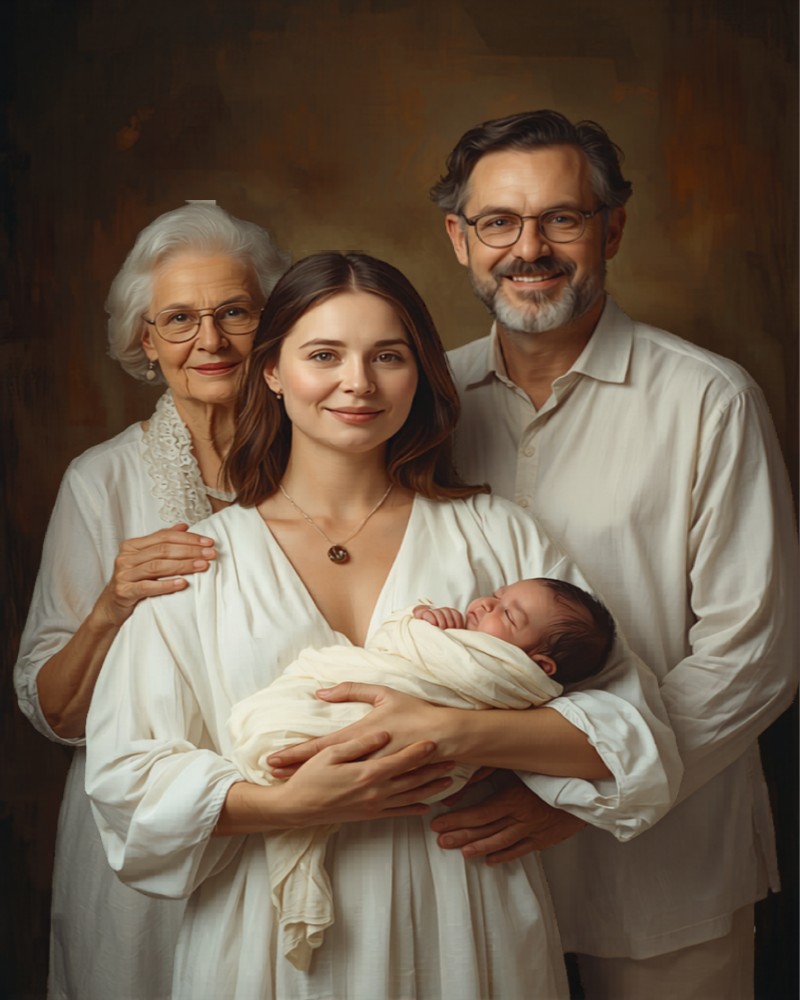
There are two honest ways to put people in one frame. A collage places photographs side by side — easy, inexpensive, and clearly a collection of separate moments. A composed portrait creates one new image, with unified light and color, as if the family had gathered for a portrait sitting that never happened. Collages remember the photos; composed portraits remember the family. Neither is wrong, but they hang very differently on a wall.
Step 3 — Beware the two classic failure modes
If you attempt a composed merge yourself or hire it out cheaply, two things go wrong again and again. First, faces drift: heavy-handed tools redraw people until they are almost-but-not-quite themselves — the single most upsetting outcome, especially for a loved one who has passed. Second, resolution collapses: a portrait stitched from small crops looks fine on a phone and turns soft the moment it is printed at 16×20. Whatever route you take, insist on seeing the result at print resolution before any money changes hands for a print.
Step 4 — How it’s composed
At Held by Generations, you upload each photograph whole — no cropping required — and simply tell us who each person is: mother, grandfather, daughter. Your photographs are composed into one warm, painterly portrait, preserving hats, hairstyles, and glasses exactly as they appear in your sources. Up to seven people across three generations can share one frame; your first preview is ready in moments.
You then review it. If a detail is off, you say so and the portrait is regenerated — nothing prints until you approve. The approved portrait is finished at exact 300-DPI print resolution for your chosen size, on gallery thin canvas or as a framed fine-art poster, and shipped free in the US. Sizes and materials are covered in our FAQ.
A note on including those who have passed
Combining photos across time often means including someone no longer here. That deserves particular care — we wrote a separate gentle guide on adding a deceased loved one to a family photo, and our memorial portraits page explains how a departed family member can be included with dignity.
The drawer of scattered photos is not a mess. It is raw material. One afternoon of choosing, and the family that was never photographed together can finally hang on the wall together.